


What value do technology and digital solutions add, and what are their limitations?
AI and automation offer unprecedented solutions for boosting business performance. A race to adopt these technologies is underway in the supply chain—as in virtually every other field—amid full awareness of the risks posed by uncontrolled, large-scale deployment to the world of work as we know it.
While our companies are fighting to keep growing despite repeated crises, people are worried about the future of their jobs and their children.
Two issues that may seem contradictory at first glance but can be addressed through new technologies and digital solutions.


So, should we—and if so, how—strike a balance between the pace of technology adoption and the ability to transform professions and skills, including in initial training programs?
How much autonomy and expertise will robots eventually achieve? Should we want AI to become truly intelligent?

Isabelle BADOC , Director ofProduct Marketing for the Supply Chain at GENERIX
Here is a preview of one of the two panel discussions on the agenda for the upcoming RISC 2026, courtesy of our main sponsor: GENERIX.
Automate to make life easier
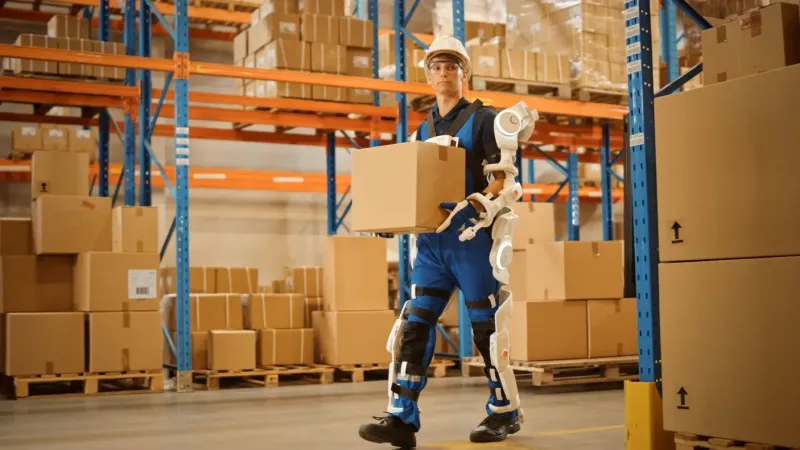
Reducing physical strain helps protect workers’ health. Reducing the mental strain of repetitive tasks and boredom helps protect their well-being at work.
Here, technology enhances human capabilities by relieving people of certain tedious tasks.
Let’s take the example of Computer Vision , which enables continuous monitoring of the integrity and compliance of incoming pallets.
This task is so tedious, and the resulting quality so poor, that it is sometimes eliminated altogether, leading to gaps in traceability and associated costs. While AI handles the tedious part of the inspection and identifies errors, humans focus on resolving them. This is a far more satisfying and motivating role.
Increase human engagement
Well-designed digital tools make the rules of the game clearer: transparent objectives, shared standards, and metrics that are understood and accepted. They enable employees to understand the impact of their actions, measure their contribution, and make progress. Technology then becomes a driver of engagement, rather than a tool of control that is imposed on them.
Here, technology enhances human potential by giving meaning to people’s work.
Let’s take the example of performance analysis and activity reports. With AI, the role of the manager is transforming. Today, managers are essentially Excel experts who spend a significant portion of their time chasing down information and processing it to present it in a clear and coherent way. With AI, they become the architects of an efficient and fast information system. They connect more information sources, streamline and standardize input data, and build reports that are more readable and robust—which enhances their value. They save time and can better focus on identifying new performance drivers. They make the results that inform their decisions more transparent and strengthen their oversight, leading to greater engagement among their teams.
Help decide

Example of how generative AI can be used to support maintenance technicians (best practices guide from the Digital Techno LAB)
Gain insights from a wider range of data and information from various sources, both internal and external.
Be able to simulate numerous scenarios to compare results by varying assumptions at breakneck speed. Decision support is a highly valued application of AI in supply chain operations, particularly in execution, which must constantly adapt to all kinds of unforeseen events.
Which orders should I prioritize when I don’t have time to process the entire order book? How will this delay affect my schedule tomorrow?
Do I need to hire additional staff? How much will that cost? Who can I call on at the last minute? How can I get started quickly?
With specialized AI agents or models that are well-fed with data, even a junior team leader can fully control their schedule and budget. They can ensure the best work environment and level of engagement among their team members.
Here, technology enhances human capabilities by helping people make better decisions more quickly.
Transforming management
With the advent of technology, the role of the manager is evolving. It is no longer just about “getting things done,” but about “fostering growth”: developing versatility, supporting skill development, and safeguarding critical human know-how and expertise. Managers are learning to assign tasks to different types of resources (technological or human), creating mixed teams and integrating AI agents as members of their teams. Of course, they are training themselves and their teams in “prompt” usage.
Here, technology enhances human capabilities by helping people manage more effectively.
Understanding the limitations of AI… as of now… and the role of humans in effective collaboration
Human review and approval required
An AI system that is well-designed, well-trained, well-fed, and well-monitored should make very few mistakes. In supply chain management—and often in other fields as well—most AI systems do not yet have the necessary conditions to solve complex problems completely on their own.
To address this challenge, Breton Yann LeCun has announcedAdvanced Machine Intelligence ( AMI) Labs, which is capable of understanding the “real world”—that is, the context of a problem and its environment—thus overcoming the limitations of current AI models, which merely manipulate language.
Understanding AI Results
Understanding the decision-making process remains essential when entrusting AI with certain tasks that carry high risks to human health, for example. We want to understand how and why an AI system arrives at a specific result. However, Large Language Models ( LLMs ), Deep Learning (deep neural networks), complex Machine Learning, and quantum computing remain black boxes. At best, they provide a confidence score or warn of limitations regarding the results they deliver. Humans therefore remain in charge, and AI serves as a tool and an aid.
Set decision-making priorities
AI generates results based on a specific request and context. For example, when conducting decision simulations, a human will guide the AI based on their preference between economic performance, service quality, and environmental impact. Or between robustness and hyper-optimization in an uncertain context. This precise framework ensures the relevance of the AI’s responses.

Manual precision
Emotional Intelligence
Analysis of nonverbal behavior

Enhanced capabilities
Strict rules (European AI Act)
A humanistic approach focused on people

The Augmented Human
The three-pronged promise: responsiveness, profitability, and sustainability
A supply chain powered by augmented human capabilities promises to be more responsive, more profitable, and more sustainable. It puts people back at the heart of the system’s intelligence and embraces technology while adhering to humanistic goals that ensure the long-term viability of the solutions implemented.


