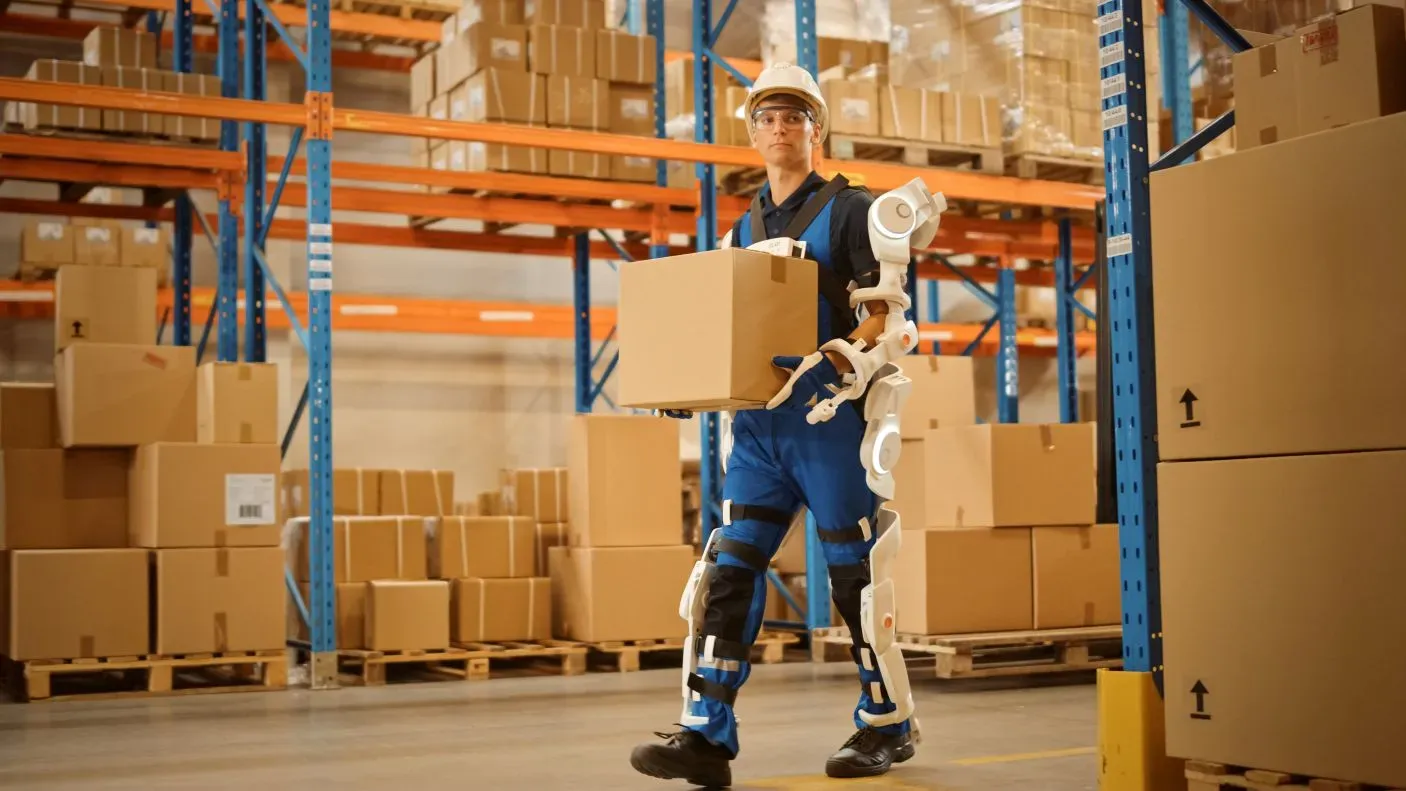
Augmented Humans in the Supply Chain: Between Innovation and Failure
Amid the rise of AI, the transformation of work methods, and the quest for technological sovereignty, supply chain professionals are seeking to balance operational performance with employee well-being. But how does innovation—often touted as a miracle solution—align with the realities on the ground?
During the roundtable discussion titled “Augmented Human: Added Value Through Technology and Digital Solutions,” experts such as Pierre Chaffardon (Generix), Vanessa Clemendot (Sanofi), Christophe Plouseau (Louis Vuitton Malletier), and Christophe Vandrome (Kuehne+Nagel) shared their insights.
AI and Resource Management: A Powerful Combination for Performance and Retention in the Supply Chain
The key challenge of AI in logistics is decision support to better manage human resources. During the roundtable discussion titled “Augmented Human: Added Value Through Technology and Digital Solutions,” Christophe Vandrome, Contract Logistics Managing Director for France at Kuehne+Nagel , shared his vision of AI-powered decision support to assign tasks based on employees’ skills and preferences . His goal is to improve both employee satisfaction and performance—and ultimately, retention.
Today, a few proof-of-concept projects are underway in Europe based on this principle, but scaling them up remains challenging because it requires evaluating HR data (skills, performance) and structuring its collection to feed into resource allocation and planning models. Christophe Vandrome also cautioned against the dehumanizing use of productivity data to manage teams : “That’s not what real life is like in our warehouses. If we want our people to be happy, we also need to manage our data in the right way and very intelligently.”

Photo credit: Nathalie Vergès Photography
Warehouse resource management was also a central topic of discussion during one of the afternoon workshops dedicated to “Technological Trends in the Supply Chain.” A live survey allowed for a comparison between the audience’s perceptions and those of the barometer published earlier this year by FRANCE SUPPLY CHAIN’s Digital & Techno LAB regarding AI in the supply chain.

According to respondents in the 2025 survey and the approximately 40 workshop participants, the main benefit of AI in the supply chain remains unchanged: demand optimization through AI (Demand Sensing). Testimonials detailed applications aimed at precise forecasting of operations—specifically, warehouseresource planning ( using Databricks, multi-parameter correlation, and machine learning, with savings of up to 10% on resource costs)—a summary of which is provided below:
Work Methods and Failures at the Heart of Innovation
All the panelists agreed on the importance of experimenting quickly, accepting failure, and pivoting in the context of digital or technological transformation projects. Pierre Chaffardon, General Manager for EMEA North & APAC at Generix, illustrated this point by noting that the value of AI lies in the ability to experiment and make mistakes quickly, retaining only those use cases aligned with business objectives : “In the area of computer vision, we developed dozens of use cases to test with clients [through co-creation] before ultimately selecting just two that we’re now scaling up.”
Christophe Plouzeau, CIO of Louis Vuitton Malletier, believes that innovation requires accepting a failure rate of 20 to 30 percent of initiatives. He emphasized the need to measure the actual adoption of tools on the ground (far from the Paris offices) and the upheavals caused by Asian countries : “You need to have local teams. You need teams that are capable of immersing themselves in that culture.” Of course, there are regulatory considerations; China demands Chinese solutions, so we have to adapt to that. But generally speaking, Asia has invented—particularly in its interactions with customers—social networks that are central to people’s lives […] these are ecosystems we need to master, and we can’t do that effectively from Paris.”
Between Agility and Deconstruction
The enhancement of human capabilities through AI will bring about lasting changes in the way we work. As teams gradually become more familiar with everyday AI tools—such as enterprise ChatGPT— the groundwork is being laid for more structural transformations. During her presentation at RISC, Vanessa Clemendeau, SVP – Global Head of Supply Chain at Sanofi, shared her conviction:“Organizations must prepare for an era of AI agents; my generation is the last that will have to manage only humans. In the future, we will be managing mixed teams of autonomous agents and humans.”
Data, LLM Models, and Sovereignty

Photo credit: Nathalie Vergès Photography
In response to a question from the audience about data processing prior to the deployment of a digital tool, Christophe Vandrome recommended not waiting for perfect data before launching AI projects : “We get started even if the data isn’t good, and then we make adjustments. In fact, it’s a constant process of refinement. Very often, the data our clients provide isn’t necessarily comprehensive.”
Vanessa Clemendeau added ,“AI also helps us organize the data when that hasn’t been done beforehand. That was the case at Sanofi, which ran a lot of AI models before fully structuring the data, and I was a little surprised when I joined the group. That said, it doesn’t mean it doesn’t work—it just works a little less well, and above all, we need to go back and improve the quality of the data.”
In closing the roundtable discussion, Christophe Plouzeau and Pierre Chaffardon emphasized the growing importance of sovereignty—not only data sovereignty(in the cloud) “Sovereignty isn’t just about France; it’s a regionalized sovereignty, likely spanning at least three or four geographic regions, ” but also of AI models (LLMs) to avoid a new strategic dependency : “We’re not talking about dependency on infrastructure, but rather a dependency on LLM models that we’re all capable of deploying very quickly within our companies.”
The insights shared at the RISC events show that AI and digital tools offer powerful tools for optimizing resource management, anticipating needs, and even rethinking work methods. However, their widespread adoption faces significant obstacles: data quality, the diversity of sites, resistance to change, and the need to maintain a human touch in team management.
The speakers agree on one point:
The Supply Chain of Tomorrow Is Being Built Today
And perhaps that is the real challenge of growth.
TO watch the replay