Author : Elorri THICOIPE

LAB Jeunes puts slow logistics under the microscope

A fundamental question arises: is speed at all costs the only possible path to a high-performance, desirable and sustainable supply chain? It is in this context of tension between the contradictory expectations of consumers and ecological and economic imperatives that the concept of slow logistics takes on its full meaning. Far from being a step backwards, this approach proposes a re-evaluation of speed, not as an end in itself, but as an element to be optimized in the service of more thoughtful, more resilient and more responsible logistics.

This article from LAB Jeunes invites you to demystify slow logistics and slow down. Because choosing "better" over "faster" is already changing the world.

The customer experience: Instantaneous versus Durability

Generations Y (Millennials), Z and the emerging Alpha Generation have profoundly transformed customer relations. Having grown up in a hyper-connected world, these demographic groups are characterized by a thirst for immediacy and an unprecedented demand for personalization.

For them, waiting has become an anomaly rather than a norm.

The notion of acceptable lead times has been drastically reduced: "delivered in 24 hours", or even on the same day. This demand for responsiveness imposes an unprecedented level of flexibility and precision on the supply chain, from automated inventory management to meticulous orchestration of logistics flows. The slightest delay or mishap can damage customer satisfaction, and even brand loyalty.

To meet these demanding needs, many companies have had to adopt omnichannel marketing. This customer-centric strategic approach harmonizes, integrates and synchronizes all communication, sales and service channels. Logistics thus become a key differentiating lever in a saturated market, where competition often comes down to the last few meters of delivery.

When customers also demand sustainability

Urban parcel flows are set to increase by 78% by 2030, threatening to saturate infrastructures and increase the carbon footprint of e-commerce.

Rodrigue Branchet Fauvet, permanent member of Lab Jeunes, E2E Supply Graduate Program at Renault Group

At the same time, these same consumers, particularly the younger generations, are increasingly sensitive to environmental issues. They expect brands not only to meet their immediate needs, but also to act responsibly. An eloquent figure underlines this trend: 80% of consumers say they are ready to switch brands in favor of a company more committed to sustainable development.

Companies must now combine immediacy and eco-responsibility, two often conflicting objectives. As a result of this dual requirement, and under increasing regulatory pressure, the link between Supply Chain and customer satisfaction has been considerably strengthened, particularly in the B2C e-commerce sector. One of the main challenges today is managing the last mile, i.e. the final delivery phase.

Often the most costly, the most polluting and the most visible for the consumer, last-mile management represents :

  • A key to meeting customer expectations: it directly influences customer satisfaction and loyalty. Some 88%[1] of e-buyers consider delivery to be an important purchasing criterion.
  • Rising logistics costs linked to personalized delivery (time slots, lockers, free returns, etc.).
  • Environmental impact: Light commercial vehicles used for deliveries account for around 30%[2] of greenhouse gas (GHG) emissions in cities, and urban travel accounts for a third of total freight transport emissions. The last mile accounts for around 25% of the supply chain's environmental footprint.

The World Economic Forum's 2024 report on urban logistics points out that urban parcel flows are set to increase by 78% by 2030, threatening to saturate infrastructures and increase the carbon footprint of e-commerce. Companies must therefore reinvent their business models by pooling deliveries, using soft modes (cargo bikes, electric vehicles), setting up urban micro-hubs and algorithmic route optimization.

LAB Jeunes' plea for a more effective slow logistics

Slow logistics is not a morality of slowness, it's an intelligence of tempo.

Robin Thomas-Le Déoré, permanent member of Lab Jeunes, Operations & Performance Strategy Consultant at KPMG

This speed, the ultimate argument for pseudo-performance, has made us lose sight of the real issues and consequences of a chain that's running out of control. Slow logistics is not a morality of slowness, it's an intelligence of tempo. This emerging concept suggests rethinking logistics not from the angle of immediacy, but from that of responsibility.

This starts with a simple gesture: make the trade-offs visible. When making a choice, customers need to know what their option weighs in terms of CO², reliability and total cost. When the footprint and probability of delivery are displayed, the purchase ceases to be a gamble and the experience becomes enlightened and responsible.

Reprogramming the tempo means distinguishing the urgent from the hurried. Not everything deserves to arrive tomorrow morning. The vital, yes; the current, no. We would add that a high-performance chain :

  • assumes differentiated cadences ;
  • consolidates when relevant;
  • mutualize when possible.
  • is based on micro-hubs that bring people together without getting in the way;
  • shift to low-carbon modes that reduce the environmental footprint without sacrificing reliability;
  • is based on shared data that harmonizes rather than obscures.

As for the city, it can no longer absorb the infinite addition of solitary solutions. The next frontier isn't a higher warehouse or a faster van, it's interoperability (coordinated slots, common interfaces, hubs open to multiple operators and a shared data language).

We're convinced that where there's cooperation, the kilometers disappear, load factors rise, and the promise made to the customer becomes more reliable. Cooperation is not a concession; it's a productivity booster.

Emma Arrondeau, permanent member of Lab Jeunes, S&OP International Planner at L'Oréal

Our generation doesn't wait for permission to try: it tests, measures and publishes. Give it a year, and it will demonstrate that a proportion of urban flows can be shifted to rail, river or cargo bike; that returns can be avoided through better packaging design and more honest dialogue; that the promise "sober by default, express on justification" raises service levels without lowering satisfaction. Give it shared metrics, and the competition will be on total performance, not display speed alone.

This plea is not a renunciation of progress: it is its demand.

Progress isnot about arriving earlier and earlier, but about arriving at the right time, at the right cost, with the smallest possible footprint. No technology is hostile to this vision: AI that predicts, data that sheds light, tools that orchestrate rounds and avoid empty runs all serve the same ambition, as long as accountability is accepted.

The aim of LAB Jeunes, and of our generation as a whole, is to get to grips with these issues, which reconcile competition and cooperation, performance and efficiency, consumption and responsibility.

When intention collides with reality

Slowing down flows in order to think about them more effectively means accepting a new logistical grammar made up of correspondences, breathing spaces and fruitful downtime. But the market still conjugates everything in the present tense...

Maxime Bouquin, permanent member of Lab Jeunes

As soon as you open the door to a warehouse, the poetry of intention collides with the architecture of reality. Slowing down flows in order to think them through means accepting a new logistical grammar made up of correspondences, breathing spaces and fruitful downtime. But the market still conjugates everything in the present tense: saturated rails, limited river slots, micro-hubs that are all too rare outside hypercentres. Consolidation of orders promises better-filled trucks and more fuel-efficient shuttles, but it also brings uncertainty to the table. A storm on the Rhone corridor, a delay on a lock, and the whole score shifts. The "reasonable deadline" then becomes a fragile promise: too ambitious, it frustrates; too cautious, it discourages.

Economic truth speaks without emphasis

Building a "slow"network requires patient capital, an investment aimed at operational savings and reduced risk. Shared hubs that can't be rented by the day, reusable containers that need to be tracked, washed and repatriated, secure data platforms to orchestrate sharing between competitors: this is CAPEX at the service of a more sober OPEX.

The message to shareholders is clear: inventory is not the only item that ties up capital; the absence of shared infrastructure, reuse loops and interoperability also ties up value in empty runs, failed deliveries, returns, penalties and regulatory risks.

The payback here is in stable volumes, trust and transparency. The result: higher load factors, avoided kilometers, lower total cost of service and reduced non-financial risk. Slowness isn't just a fancy: it's a cost structure that improves over time.

The social limit is no less decisive

Cyclo-logistics is rightly celebrated for its discretion, its cleanliness, its way of stitching up the city. But the beauty of the gesture is not enough to protect the worker. Poorly supervised, the boom in cargo transport can create grey areas, where workers are paid by the hour and their working hours stretched to absorb irregular flows. Conversely, professionalizing the sector requires costly skills:

  • Multimodal planning ;
  • Data management ;
  • Mastery of interoperable information systems.

Slow logistics is not a return to rusticity; it's a new approach and a new way of thinking, less energy-intensive but more cognitive, which requires new skills and time.

Charly Suaire, permanent member of Lab Jeunes and Senior Consultant in Supply Chain and Operational Performance at Newton Vaureal Consulting

If fast fashion goes green, what's the point of slowing down?

And then there's our arch-rival: fast fashion and, even more so, its ultra-fast incarnation on the Web. They don't just sell clothes; they sell a permanent acceleration of desire. Micro-collections spring up every week, sometimes every day; the algorithm moves supply at the speed of a thumb, and logistics follow. Prices compressed to the extreme, fleeting traceability, instant gratification: this mechanism installs a pedagogy of reflex, an addiction to the "now" that makes any delay suspect.

The standard becomes invisible and tyrannical : delivering fast is no longer a performance, it's a must. In the face of this competition, innovation is not enough if it cannot be understood. Warehouse automation, AI for route optimization and electrified fleets are making fast logistics ever more efficient and, in some cases, less carbon-intensive.

It's a tough comparison: if fast is green, what's the point of slowing down? The answer can't be a sermon. It requires a clear contract with the customer: say what's urgent and what isn't; display, for each option, the total cost and the real footprint; recognize that waiting has a price, and that immediacy also has one, long hidden.

If slow logistics wants to make its mark... 

Slow logistics won't win by pitting morality against comfort, but truth against reflex. It must transform expectations into value, make the invisible visible (simple, published, comparable indicators) and, finally, turn cooperation into a competitive weapon. These are political as well as industrial gestures.

None of this will erase the attraction of "everything, right now". But economic history is also about storytelling and proof.

If slow logistics is to make an impact, it needs to offer both: a story that makes people want to wait, and evidence that closes the door on suspicions of inefficiency.

Gabrielle VENOT, Communication Manager for Lab Jeunes and Supply Chain Customer & Continuous Improvement Manager at ST Michel Biscuits

Only then will it be able to shift the center of gravity: no longer pitting slowness against modernity, but proposing a modernity that no longer confuses speed with progress.

At the end of the day, we never just deliver a package. We deliver a way of inhabiting time, the city and the planet. As long as speed reigns unchecked, slow logistics will appear to be in the minority. If it becomes legible, measurable and desirable, the law could change: the pace will cease to be a diktat and become a decision - ours.

Sources :

NEWS

See all the news


EVENTS

PRESS
To go further

Read more

France Supply Chain by Aslog announces the appointment of Yann de Feraudy as Vice-Chairman of the Board of Directors of ELA (European Logistics Association)

Paris, September 15, 2025

Appointment underlines France's growing influence in European logistics

With this election, the voice of the French supply chain community is further asserted within ELA, which federates 22 national associations and represents over 55,000 industry professionals in Europe and beyond.

On this occasion, Yann de Feraudy declares: "In the field, with France Supply Chain, I have contributed to defining and promoting a supply chain resilience index. This could form part of a future Global Supply Chain Index, which ELA could bring to European level."

ELA actively promotes professional training, innovation and best practice in the logistics industry. Its initiatives include certifications based on the European Qualifications Framework (EQF), annual events such as the ELA Awards, and conferences focusing on sustainability. The association also encourages collaboration between national associations to strengthen the sector.

A new Board of Directors for ELA

At the Annual General Meeting on July 15, 2025, a new Board of Directors was elected. On August 4, members voted to allocate functions within the Board. Here is the composition of the Board:

  • Markus Mau (BVL Germany) - Chairman
  • Ramón García (CEL Spain) - Vice-Chairman
  • Mirek Rumler (CLA Czech Republic) - Vice-Chairman
  • Yann de Feraudy (France Supply Chain by Aslog) - Vice-Chairman
  • Konstantinos Haniotis (HILME Greece) - Vice-Chairman
  • Xavier Rius (ICIL Spain) - Vice-Chairman
  • Jan Eberle (GS1 Switzerland) - Board member
  • Jyri Vilko (LOGY Finland) - Board member
  • Igor Žula (SLA Slovenia) - Board member
  • Franz Staberhofer (VNL Austria) - Board member

Sharon Kindleysides has been appointed Treasurer.

An index for modernizing logistics performance

Among the high-impact projects supported by ELA is the creation of a European supply chain performance indicator. This would complement and update the World Bank's Logistics Performance Index, which is currently considered insufficient to reflect the current challenges of resilience, sustainability and innovation.

*****************************************

About ELA

TheEuropean Logistics Association (ELA ) federates 22 national associations in Europe and beyond, representing over 55,000 logistics and supply chain professionals. The ELA promotes professional training, innovation and best practices, notably through certifications based on the European Qualifications Framework (EQF), annual events such as the ELA Awards, and conferences focusing on sustainability. https://www.elalog.eu/

About France Supply Chain

The FRANCE SUPPLY CHAIN BY Aslog community works to strengthen the impact of the Supply Chain on corporate competitiveness, and to make it a lever for a more sustainable world. The association brings together 450 French and international companies of all sizes and in all business sectors, as well as Grandes Ecoles and training organizations. This 5,000-strong network of professionals, lecturers and students pools ideas and experience to provide Supply Chain players with concrete solutions. https://www.francesupplychain.org/

Press contact: Marie-Laure Laville -MLD Consulting - Tel: +33 (0)6 18 14 85 36 - Email : mllaville@mldconsulting.fr

Digitizing better and more: the guide to putting your data under control

The data governance is a powerful lever for improving performance, securing operations and preparing for the future from Supply Chains (AI, automation, compliance, etc.). To reach this level of maturity progressive digitizationof the Supply Chain is essential. Discover in this article the work of the members of LAB Digital et Technologies who who have been working on the subject since 2024, to provide accessible tools even with limited and expertise.

No AI without data

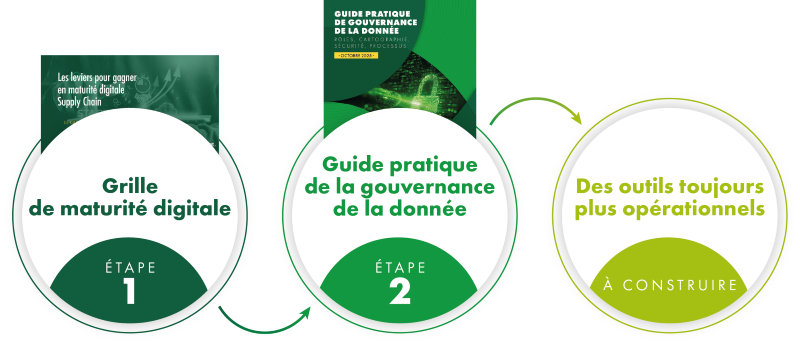
The story began a year and a half ago, with the design of a "digital maturity grid". This resource enables us to define a company's transformation potential a company's transformation progressin complete autonomy (link at end of article).

The major finding of the discussions and design of this 1st guide was: no maximum digital maturity, no logical Event Driven logic (i.e. an augmented operator and a system that acts) without complete complete mastery of its data.

The "maturity grid" squad was transformed in 2025 into a new squad with a focus data governance.

This new group of members is now publishing its practical guide. 

Guide reserved for association members

Download

photo by Saad KADIOUI

Saad KADIOUI

Partner / Head of IS Transformation CITWELL

"Data quality is key to supply chain efficiency chainData quality is key to supply chain efficiency, but I find that many of my customers have poor control over it. This is precisely where governance plays a central role: although it is often neglected as being restrictive and not very visible in the short term, it is the essential lever for this control. Without it, it's impossible to guarantee reliable data, and the the company misses out on the real opportunities for excellence provided by new data technologies (data science, data platform, AI, etc.).. "

PHOTO BY Philippe gourbeyre

Philippe GOURBEYRE

Supply Chain Owner - Michelin

"Faced with the rapid proliferation of data, the need for responsiveness in decision making, compliance in an increasingly large ecosystem, and opportunities with new technologies (Artificial Intelligence, Machine Learning, ...), Data transformation requires well-defined roles and responsibilities. Setting up governance will enable everyone in the company to understand their role in the data lifecycle and assume responsibility for it."

Pragmatic digitalization accessible to all

The 2 publications follow the same same guiding principle: to aim for operational practices that are easy to implement. With these tools, the members demonstrate that digitizing the supply chain is accessible even with limited resources, as it is a gradual process (we have included a glossary for the uninitiated).

Two guides offering a pragmatic, step-by-step approach step-by-step, pragmatic approach to structuring yourto structure your practices around pillars.

The 3 pillars of Supply Chain digitalization :

        • DATA

        • HUMAN

        • TECHNOLOGICAL BUILDING BLOCKS

        The 4 pillars of data governance :

              • Clear, recognized roles and responsibilities.

              • Reliable, shared data reliable and shared.

              • Safety adapted to uses and regulations.

              • Management processes controlled, documented and measured.

                    When we talk about alignment with the field, we're referring first and foremost to tests and implementations of the grid carried out by other squads and members on topics such as S&OP, data governance for CO2, bonded warehousing or AI GEN.

                    In the context of data governance, recommendations can seem very theoretical and rigid, but here we remind you of the importance of taking into account the reality on the ground. This guide and its pillars must be adapted to your reality.

                    Being concrete and actionable has always been a priority for LAB. This is also reflected in the availability of techniques and methods methods (diagnostic tables, concrete examples, diagrams) to facilitate implementation in your context.

                    A guide to mastering your data: a rewarding co-construction project

                    Let's talk to the guide's editors to understand the importance of this project for organizations.

                    Photo by Olivier Weis

                    Olivier Weis S&OP Business Development Manager - Renault Trucks

                    "In Business Development activities within the S&OP department at Renault Trucks, being able to rely on quality data, i.e. data in which there is a high level of confidence, is essential. This is all the more true where the concept of "Citizen Development" is concerned (i.e. user departments develop their own tools on the basis of the data models made available to them). 

                    Raw or, more often than not, transformed, data is the indispensable cement in the management of our supply chain , and in the decision-making process. That's why data governance processes, which are increasingly solid, structured and documented, are becoming more and more important, enabling us to make better use of our data on a daily basis. 

                    Photo by Olivier Weis

                    Delphine CUVELLIER French Customs Manager - ALSTOM

                    "When we think of customs, the first thing that comes to mind isn't necessarily data. However, we are also impacted by digitization, which is changing our practices and professions, and this is only the beginning. We are at the dawn of a data-driven revolution, which is redefining not only our tools, but also the interactions between public and private players. That's why I wanted to take part in this work. 

                    In the customs field, this transformation is accelerating thanks to the transposition of the Union Customs Code (UCC) into data and the imminent arrival of the European Data Hub. These developments mark a strategic turning point: data is becoming an essential lever for performance, compliance and anticipation.  

                    For customs authorities, the challenges are many and varied. Firstly, to intelligently target goods flows by detecting anomalies and fraud risks, such as undervaluation or inconsistencies in declarations. Improving service performance, by providing an overview of an operator's exchanges. And combat illicit trafficking by exploiting massive data with the help of artificial intelligence. 

                    For economic operators, data is also becoming a strategic tool. It enables them to anticipate protectionist measures and adjust sourcing strategies. It facilitates the integration of customs regulations and associated costs into the supplier selection process. And it helps secure supply chains and optimize international flows.  

                    It's always a great pleasure to share and exchange ideas on key subjects, and I hope that this collaborative work will be of use to other professions." 

                    The adventure continues - contact us to find out more!

                    NEWS

                    See all the news


                    EVENTS

                    PRESS
                    To go further

                    Read more

                    Prize for the best sustainable supply chain article - 2024 Edition

                    As part of Lab Supply Chain 4 Good, France Supply Chain and the the International Association for Research in Logistics and Supply Chain Management (AIRL-SCM) launch the 3rd edition of the Best Sustainable Supply Chain Article Award.

                    The objective of this initiative is to reward a scientific publication that makes a significant contribution to the field of sustainable supply chain management. This operation allows to highlight academic works of excellence in the specific fields of logistics management and Supply Chain Management.

                    Who can participate?

                    The 2024 edition of this prize is open to teacher-researchers who have published an article in one of the two journals associated withAIRL-SCM or in a peer-reviewed scientific journal in the field of Supply Chain Management between January1, 2023 and December 31, 2023. Papers may be submitted in French or English.

                    What are the evaluation criteria?

                    A jury, made up of teacher-researchers who are members of France Supply Chain and members of the AIRL-SCM, will evaluate the articles according to the following criteria:

                    Importance of the topic for France Supply Chain members (e.g. link with Labs, link with Manifeste pour une Supply Chain frugale et désirable)

                    Potential impact of results (e.g., potential to influence decisions in business or public organizations)

                    Nature of research contributions: academic, methodological, managerial

                    Innovative nature of the research

                    Practical application and consideration of ecosystems

                    The winner(s) will receive a €2,000 prize from France Supply Chain. The award ceremony will take place in La Rochelle during the Rencontres Internationales de la Recherche en Logistique, on May 29, 30 and 31.

                    How and when to apply?

                    Entries for this "Prize for the best article in Sustainable Supply Chain -Edition 2024" consist of an electronic file including:

                    The application form

                    A short curriculum vitae of each author with a list of recent publications

                    Thepaper submitted for the award, giving full publication references

                    The 2024 winners

                    This year, the Best Sustainable Supply Chain Article award failed to decide between the last 2 papers in the running, so deserving were they of the award, on very distinct themes. We therefore have 2 winners in this 2024 edition:  

                    Ex-aequo: Introducing a framework toward sustainability goals in a supply chain 4.0 ecosystem by Saoussane Srhir, Anicia Jaegler and Jairo R. Montoya-Torres of Kedge Business School, France and School of Engineering of Universidad de La Sabana, Colombia.

                    The authors argue that Industry 4.0 technologies are the innovation capacity that should be supported to move supply chains from their linear model, known for its high energy and resource consumption, to a circular model where technology replaces intermediaries and drives operations towards sustainability and efficiency.

                    The study demonstrates the impact of integrating Industry 4.0 technologies into each of the Supply Chain Operations Reference Model (SCOR) processes to build Supply Chain 4.0, and links the resulting capabilities of this transformation to the potential achievement of the Sustainable Development Goals (SDGs).

                    Ex-aequo: Cognitive digital twins for freight parking management in last mile delivery under smart cities paradigm by Yu Liu, Shenle Pan Thierry Coupaye, Pauline Folz, Fano Ramparany and Sébastien Bolle from Mines Paris, PSL University, Centre for Management Science (CGS), i3 UMR CNRS, France and Orange Innovation, France.

                    This paper examines the problem of Freight Transport Parking Management (FPMP) for last-mile delivery in the context of smart cities where objects are managed by digital twins.

                    The results suggest that the connectivity of digital twins translates into :

                    • greater logistical efficiency,
                    • a reduction in negative externalities
                    • better use of resources.
                    • potential new business services for logistics service providers
                    • new management information for municipal planners and decision-makers.

                    This paper also presents a case study of parcel delivery in Paris using Orange France's Thing in the future (Thing'in) platform to demonstrate a real-world application of this approach, complemented by a prototype mobile application.

                    Discover the 2023 prize list.

                    Le Mensuel de la Supply Chain #12

                    Find this month : 

                    • The team rests
                    • Manifesto: community actions
                    • Green Radar: instructions for use
                    • Publication: SC compensation survey
                    • Soluciones digitales para mis operaciones de transporte
                    • What to expect in the coming months

                    Welcome to our new members from RELEX SOLUTIONS and TD SYNNEX who have joined the association since our last newsletter!

                    Behind the scenes

                    The team at the helm and its Chairman, Yann de Feraudy

                    2023 is ending on a high note, and the French Supply Chain team is no exception.

                    End of October : Magverlands Guervil alias Lands joins the team as Member Experience Manager.

                    Mid-November: the1st workshop dedicated to the Circular Supply Chain brought together 50 people over the course of a day.

                    End of November : Yann Laridon joins the team as PMO.

                    Mid-December: we welcome nearly 300 people to our congress, which this year takes on a European dimension with, among other things, the ELA Awards ceremony!

                    And we publish the new version of the Manifesto!

                    None of this would be possible without our members and partners.

                    So thank you and have a wonderful holiday season! See you on Tuesday, January 2, 2024, with full batteries!

                    Relive the highlights of For Supply and Beyond

                    * Non-exhaustive list 😉

                    The actors

                    France Supply Chain publishes the full text of its new Manifesto and calls for a Frugale et Désirable Supply Chain

                    The aim of this founding document is to shed light on the future of the industry, and make it a desirable one. It is divided into 4 chapters and 19 fact sheets, supported by examples that are the fruit of the collective intelligence of its 4,900 members. With this plea, the association hopes to inspire Supply industry players and help them take action.

                    Discover the community's concrete actions

                    On display

                    Why and how to use Green Radar Supply Chain?

                    Find the answers in this article, the webinar replay and the open-access publication.

                    ------

                    Discover testimonials and radar

                    Supply Chain executive compensation survey in collaboration with Michael Page

                    A detailed study of remuneration for Supply Chain management positions in France: salary, variable, increase.

                    ------

                    Detailed study

                    Soluciones digitales para mis operaciones de transporte disponible en ESPAGNOL 🇪🇸

                    This White Paper has been designed to help you in your transformation process, and to clarify your choices in the face of new uses and solutions.

                    ------

                    Descargar el Libre blanco

                    The next sessions

                    EN 2024 :

                    05/01 -[LAB] Digital & Technologies Lab remote meeting

                    01/18 or 01/24 - [LAB] SupplyChain4Good Lab physical meeting

                    01/17 - [Webinar] Inspiring Webinar: one-to-one with the Industrial Director of Ateliers de Maroquinerie Louis Vuitton

                    01/23, 24, 26 - Meetings of the American Supply Chain Community - MONTREAL - NYC - CHICAGO

                    01/29 - [Workshop] Hydrogen Encounters #1

                    01/30 to 02/01 - [Show] Hyvolution Paris 2024

                    03-26-28 - [Exhibition] CELO Connect Warehouse & Logistics

                    More than 40 candidate CVs, updated every week, are available on the ICI website.

                    To subscribe to our newsletter, please fill in this form:

                    " * " indicates required fields

                    Identity*
                    Newsletter

                    France Supply Chain by Aslog and Michael Page publish their Supply Chain Salary Survey 2023

                    France Supply Chain and Michael Page have once again combined their expertise to publish a comprehensive study of remuneration for Supply Chain executive positions in France. The current job market is under pressure, and there is a shortage of candidates in the logistics and supply chain sectors. The aim of this survey is to assist readers in their recruitment or job search, thanks to detailed responses from over 1,200 professionals.

                    A detailed benchmark of the remuneration offered on the market: salary, variable, increase, etc.

                    The figures revealed in the first part of this new survey are based on a number of parameters developed in the "job focus" section. Expertise, career path and sector of activity all provide a clear picture of remuneration.

                    In addition to fixed remuneration, variable remuneration and annual increase policies are the subject of in-depth study. These are strategic levers for companies in these times of inflation, volatility and talent shortages.

                    remuneration-supply-chain-manager

                    Manager / Supply Chain Director: sought-after, high-paying profiles

                    In 3 years, from the end of 2019 to June 2022, the number of job offers for these positions has risen from 50 to 100 per week. Companies of all sizes and in all sectors are looking for experts capable of meeting the many challenges facing Supply Chain functions (securing flows, optimizing inventories and logistics/transport costs, digital transformation or CSR issues).

                    Feminization of professions and pay gap

                    With 31.3% of respondents being women, the survey reveals that the proportion of women in the supply chain is lower than the national average for managers. This disparity is even more marked when we look at positions of responsibility (9% of management positions).

                    A major focus is therefore devoted to the areas of work and solutions to be deployed in order to remedy this under-representation of women and workforce tensions.

                    Links :


                    About France Supply Chain

                    The FRANCE SUPPLY CHAIN BY Aslog community is committed to strengthening the impact of the Supply Chain on business competitiveness, and making it a lever for a more sustainable world. Our network of 4,900 members, professionals from all business sectors, academics and students, pool ideas and experience to provide Supply Chain players with concrete solutions.

                    The workshops held in our LABS and self-help communities are great places for reflection, exchange and progress. Our actions and projects are guided by 3 key principles: our ability to set the standard, to leverage collective intelligence via our communities, and to increase our capacity to influence essential developments.

                    Press contact

                    Elorri Thicoïpé - Communications Manager 

                    elorri@francesupplychain.org

                    06 21 28 82 74

                    About Michael Page

                    Michael Page's Purchasing Supply Chain practice is currently present in 12 European countries, and recruits over 5,500 people a year. Regular exchanges between our teams in the field and our international key account unit guarantee responsiveness and efficiency.

                    Michael Page meets all Supply Chain challenges thanks to its in-depth knowledge of industry trends, and the expertise of its consultants in the professions for which they recruit.

                    Press contact

                    PLEAD - rawa.el-majdoubi@plead.fr

                    06 68 32 12 49

                    Supply chain risk barometer - 5th edition

                    Geopolitics, economics, climate, consumption, regulations... in an increasingly unstable environment, the very model of globalization and globalized supply chains has been called into question for several years.

                    Companies have realized that the complexity and rigidity of their Supply Chain could represent an existential risk in the event of the failure of a single link. The challenge now is to adapt their strategy in order to regain control in a world of uncertainty, where agility will be decisive!

                    This 5th edition of the KYU Supply Chain Risk Barometer, carried out in partnership with Arts & Métiers, France Supply Chain and AMRAE, is an opportunity to take the pulse of the Supply Chain, measure the evolution of the risks to which it is exposed, assess the maturity of organizations to face new challenges, identify and share trends and best practices.

                    Complete the questionnaire and receive a preview of the new editionat the end of January 2024

                    Participate

                    • No questions are mandatory, and all data will be anonymized to guarantee the confidentiality of your contribution.

                      If you don't have enough time to complete the whole questionnaire, your answers will be saved at the end of each page, and you can return to them at any time by clicking on the link above.

                    The results will be published in early February 2024.
                    • In the meantime, we invite you to (re)discover the4th edition of the barometer. 

                      Read the publication 

                      If you'd like to find out more about KYU, please visit their website.

                    We thank you in advance for your contribution and remain at your disposal for any questions or problems you may encounter at the following address risksupplychain@kyu.fr

                    The personal information collected by KYU Associés is processed in a totally anonymous manner, for the sole purpose of producing the results of the survey. The data will be kept by KYU Associés for the time required to produce the survey results, and will then be destroyed.

                    In accordance with Regulation (EU) 2016/679 on the protection of personal data (RGPD), you have the following rights over your data: right of access, right of rectification, right to erasure (right to be forgotten), right of opposition, right to limit processing, right to portability. You may also define directives concerning the conservation, deletion and communication of your personal data after your death. You may, for reasons relating to your particular situation, object to the processing of data concerning you.

                    To exercise your rights, please send your request to risksupplychain@kyu.fr. A copy of your identity card may be requested. If you do not-respect of these obligations, you have the right to lodge a complaint with the CNIL.

                    NEWS

                    See all the news


                    EVENTS


                    PRESS

                    Read more

                    Le Mensuel de la Supply Chain #11

                    Find this month : 

                    • European Sinergy Workshops
                    • Calling for a Frugal and Desirable Supply Chain
                    • Webinar: Green Radar for your CSR strategy
                    • Guide: automate your warehouse with rapid ROI
                    • Replay: green gases to decarbonize your fleet
                    • Article: The Risk Management community reveals itself
                    • What to expect in the coming months

                    Welcome to our new members from LOCUS ROBOTICS, SPL, STACI, EPALIA, BONY and ANJAC, who have joined the association since our last newsletter!

                    Behind the scenes

                    As good Supply Chain Managers, we decided to optimize the time and travel of our European colleagues. The European Synergy Workshops were born!

                    The day after For Supply and Beyond, some of you will be taking part in workshops to share and connect with the European champions present the day before.

                    Our aim is to join forces to influence the essential changes in supply chains.

                    The 3 workshops will cover issues such as digitalization / human resources management and inclusion / business sustainability.

                    The actors

                    In 2021, France Supply Chain published its first Manifesto, projecting itself into 2030 in a world of more sustainable supply chains. At the time, as COVID came to an end, the idea of the "next world" delighted the most committed among us, and it was easy to project ourselves into a radically different near future.

                    2 years on, it's clear that little or nothing has changed, and that the world of tomorrow is a long way off. Nevertheless, supply chain managers are aware of the role they have to play in the fight against climate change, and that every tenth of a degree, and therefore every effort, counts.

                    A strong conviction has emerged at France Supply Chain: the Supply Chain of the future must and will be desirable , between frugality, circularity and collaboration, the key elements and foundations of the appeal launched in the Manifeste 2023.

                    Florence Mazaud, Sustainable Solutions Manager at Sightness and leader of the Manifesto redesign to be unveiled on December 12

                    On display

                    Webinar Green Radar Supply Chain 2023: Presentation and feedback from Michelin and DB Schenker

                    Our guests will explain how this type of exercise can be part of a company's CSR work and decarbonization action plan.

                    ------

                    Register for Live on December 5

                    The "Optimizing logistics sites: what are the quick wins thanks to automation" now available to all

                    Discover the quick wins within your reach with automation under €1M.

                    ------

                    Download the publication

                    Supply Chain Risk Management now has its own community of experts

                    risk management

                    France Supply Chain wants to help the profession to collectively develop its skills.  

                    ------

                    Find out how

                    The next sessions

                    22/11/23: [Workshops] "What's this loop?" Building a circular supply chain 

                    11/27/23: [Conference] Supply Chain as a key player in reindustrialization - Arts et Métiers / France Supply Chain / X / CentraleSupelec

                    11/28/23: [Round table] FUTUROPALETTES - The wood pallet in the supply chain of the future

                    11/30/23 : [Evening] L'Afterwork du flambeau

                    11/30/23 : [Summit] RailTech Summit

                    05/12/23: [Webinar] Green Radar Supply Chain 2023: available solutions to decarbonize

                    12/12/23 : [Congress]

                    PARIS

                    12/13/23: [Workshops] European Sinergy Workshops

                    12-13/12/23: [Convention] Riverdating 2023

                    12/14/23: [Workshop] Rencontres de l'Hydrogène #1

                    12/18/23 : [Ceremony] 3rd Supply Chain Night

                    01/30 to 02/01/24: [Show] Hyvolution Paris 2024

                    More than 50 candidate CVs are currently available on the site, HERE

                    To subscribe to our newsletter, please fill in this form:

                    " * " indicates required fields

                    Identity*
                    Newsletter

                    Supply Chain Risk Management now has its own community of experts

                    Risk management is a profession, a set of skills and a state of mind that organizations need to develop. Does this profession already exist in your company? By creating a dedicated community, co-hosted with Renault Group and the consulting firm Wavestone, we hope to help the profession collectively develop its skills, thanks to feedback from the various participants and the methodological insights of our facilitators.

                    In this article, we look back at the community's first workshop on Supply Chain risk classification and the associated rating methodology .

                    Enterprise risk management, a prerequisite for speed and resilience

                    "The Covid-19 crisis and the war in Ukraine were the catalysts for the loss of control over supply chains. They revealed our customers' lack of anticipation and preparation for risk management". Wavestone's testimony on risk management within organizations sheds light on how far we still have to go.

                    The growing number of crises and the uncertainty that accompanies them have prompted companies to strengthen their crisis management processes. Nevertheless, these efforts are mainly focused on reacting to proven risks, rather than on preventive measures to mitigate exposure to risk and know how to act accordingly.

                    Supply Chain risk management is part of the company's overall risk management. It involves controlling risk factors, events and circumstances that could compromise the Supply Chain in all its activities.

                    Supply Chain risk management as part of overall corporate risk management

                    Implementing a risk management process is becoming a prerequisite for a sustainable business model. It is a response to the challenge of controlling the supply chain, but also to economic issues (control of industry costs), commercial issues (service levels and relations with partners) and issues of national sovereignty (relocation of production and independence of the French model).

                    Renault Supply Chain challenges:1st feedback from the community

                    "The risk of product shortages linked to capacity limits, lack of raw materials and manpower" represents the number 1 risk for organizations in 2023" (Source: KYU,4th Risk Barometer), which means that companies will need to monitor their supplier relations more closely.

                    Thierry Blein, SupplyChain governance, performance & risks officer at Groupe Renault, adds that the current context is characterized by an upsurge in risks:

                    1. Climatic risks , with the example of flooding in Slovenia forcing some automakers to close their sites for a time.
                    2. Scarcity of raw materials such as copper, demand for which is around 4 times greater than the volume mined.
                    3. Loss of talent , with a general increase in the number of people leaving the supply chain and a lack of attractiveness of the field, which is struggling to recruit.
                    4. Operational due to rising transport costs, container shortages and capacity risks.

                    risk-management-supply

                    One principle: Learn to navigate the New Normal

                    To cope with this new environment, we need to change our corporate philosophy. From now on, we need to take into account the level of risk and resilience of the Supply Chain in our sourcing decisions. The automotive manufacturer also indicates that it is working on the major issues of product standardization to reduce the complexity of its Supply Chain, better capacity management and more reliable forecasting.

                    Risk mapping and rating methodology: the fundamentals of good risk management

                    The aim of this first meeting was to present Renault's approach to risk mapping and management. The upstream identification phase is based on a census of the main risks that could hinder the achievement of the organization's objectives. This approach is replicated at the level of each department.

                    For each element detected, a risk tolerance rating scale is set up and translated into a highly visual mapping.

                    risk mapping

                    The Renault risk map

                    Once the situation has been assessed, success can be summed up in two words: governance and management. The Group has therefore decided to position the Supply Chain function at the highest corporate level (CEO-1). This allows for a more cross-functional approach and a holistic view of risks. The decompartmentalization of data also leads to cross-functional decision-making governance.

                    In concrete terms, risk management action plans are monitored 2 or 3 times a year by the SCM CODIR, and each department (business line) is responsible for managing the risks associated with its activity, through the appointment of a Risk Owner. For example, the risk of talent attrition is managed by the HR department. Similarly, the "transport capacity" risk is the responsibility of the Logistics Engineering Department.

                    Upcoming group sessions: climate, technological and cybersecurity risks

                    Session #2 on 18/10: Supplier relationship management, led by Wavestone, with feedback from Sopra Steria in the aeronautics sector.

                    Session #3 on 29/11: Technological risk management & Cybersecurity, led by Wavestone

                    Session #4 - date to be confirmed: Climate risk management, led by Wavestone and France Supply Chain

                    Communitiesare self-help and experience-sharing groupswhere confidentiality and non-commerciality are paramount. They provide aprivileged forum for exchanges between professionals from all sectors of activity. Since 2023, they have been growing in popularity among our members.

                    Discover all our communities

                    NEWS

                    See all the news


                    EVENTS


                    PRESS

                    Read more

                    A Replay to understand biomethane: a mature alternative energy source

                    Our aim with this new webinar is to continue educating our members and beyond, logistics and supply chain professionals about the various green fuels. Biomethane in particular is a renewable energy at the crossroads of our country's energy, ecological and economic challenges, enabling us to obtain a renewable fuel called bioGNV. Our guests share their expertise on green gases and answer your questions: where to buy and at what cost? How efficient is it for mobility? Discover the many advantages and prospects of this alternative fuel for decarbonizing our supply chains.

                    Ambitions: to generate nearly 20% green gas in the French gas mix by 2030 and 100% by 2050

                    Our speakers :

                    • Élodie Dupray, Head of the BioNGV/NGV Mobility Division at GRDF
                    • Rami Hariri, Biomethane Delegate at GRDF

                    Green gas production methods and their maturity

                    There are several green or biogenic gases. They are made up of the same chemical molecules as fossil gas, but are produced in a faster, sometimes synthetic cycle. The first method of obtaining biogas is methanization, based on the anaerobic digestion of organic matter.

                    The different green gas production processes

                    In France, there are a number of different green gas production processes with varying degrees of maturity. For example, hydrothermal gasification, which uses wet biomass, slurry, sludge or microalgae, will go from R&D to the 1st network injection projects in 2025. Conversely, electrolysis with or without methanation will reach theindustrialization stage over the same timeframe.

                    Focus on biomethane

                    Biomethane is already circulating in our networks and is developing strongly thanks to mature technology. In the digester, we recreate the internal conditions of a cow's rumen: heat and agitation. The gases released by the decomposing organic matter are collected with virtually no loss of yield. The special feature of methanization is that it produces 2 products:

                    • biomethane ;
                    • digestate, which can be used as fertilizer instead of chemical fertilizer by farmers.

                    Methanization production capacity has grown exponentially in France thanks to a new regulatory framework. The distribution of production sites (mainly in Brittany and the north of France) highlights its links with the agricultural world and the agri-food industry.

                    How can biogas help us meet our Fit For 55 targets?

                    Studies show that our gas consumption will continue to fall as a result of behavioral changes (sobriety) and efficiency improvements (processes, technology, buildings). At the same time, French green gas production will grow to cover our total gas needs by 2050.

                    Renewable energy for mobility

                    Some territories already have 20% of green gas molecules in their network, while others have only 3%. It is therefore essential to bring usage and production closer together, in order to meet demand and enable people throughout France to run on biomethane fuel.

                    Based on a lifecycle analysis, a truck running on bioNGV reduces its GHG emissions by 80% (ADEME carbon base).

                    90% of goods flows can be carried out using BioGNV, thanks to its long range (up to 700 km, equivalent to a driver's tour) and its wide range of vehicles: heavy vehicles (goods, waste and passenger transport) as well as industrial trucks.

                    Vehicle ranges suitable for BioNGV/GNV

                    Inputs already widely available

                    The organic matter used to generate bioNGV does not compete with the needs of biofuel production, for example. Furthermore, the use of inputs and the need for agricultural land are highly controlled and limited. More than 90% of needs are covered by livestock effluents, intercrops that do not use biomass, and waste from the agrifood industry.

                    How to run on biomethane, and at what price?

                    There is indeed an additional cost to purchasing a CNG vehicle, but this is offset by :

                    • a more accessible fuel ;
                    • regional or local aid ;
                    • free vehicle registration (or half price);
                    • bonus depreciation.

                    To answer this question fully, several factors need to be taken into account, including how production is financed and legislative incentives. Tools have been developed to calculate the TCO and compare the cost of a biogas vehicle with other energies (electric, bio-fuel or diesel).

                    To find out more about the challenges of biogas (grid flexibility, connection, etc.), its cost and its impact on your decarbonization strategy, we invite you to watch the replay. This members-only video features a timeline so you can view only the parts that interest you.

                    To remember

                    It is estimated that biomethane provides a partial response to 3 major challenges:

                    1. decarbonizing our energy ;
                    2. decarbonizing our agriculture;
                    3. waste management.

                    Download support

                    Answers to the questions asked at this conference:

                    • One of the challenges is to connect agricultural methanizers to the gas network.

                      Today, with 12TWh, the gas network is up to the task, and its development and reinforcement have not posed any problems. The problems are under control of the gas operators.

                    • Do you see a future for trucks filling up with biogas directly at the methanization site, or will everything be done via the grid?

                      Most of these will be network stations, but on-farm distribution will be widespread in rural areas.

                    • What is ETS?

                      ETS stands for Emission Trading Scheme. This is a system for measuring CO2 emissions by companies, with the possibility for the most efficient to sell their unused CO2 emission allowances to the most polluting companies.

                    • In the event of a very high demand for biomethane, could there be conflicts over the use of agricultural products (if there is not enough waste in the anaerobic digester)?

                      The biomass used for biomethane does not come into any conflict of use. The vast majority of biomass used for biomethane is not in competition with other uses, and is not the same input as agrofuels, for example.

                    • On a fifteen-hectare site in Cérilly, near Châtillon-sur-Seine, a methanizer is rising from the ground. The plant, for which the project was born in 2018, will be fuelled by forage rye, an intermediate crop grown for energy purposes. A total of 150 local farmers have committed to producing cereals, in return for payment of course, to provide enough material for the plant to run smoothly. Some sites will pool several farmers, but in France the size remains average, even small: 3-4 producers. Sites are 10 to 6 times smaller than in other countries (Germany or Denmark). Is this example in conflict?

                      There's no conflict, as it's an intermediate crop between the main crops. No competition for use.

                    • You mentioned CO2 capture during biogas production. What progress has been made? Is this planned for both bioNGCC and bioLNG?

                      Today, all anaerobic digestion sites operate in a gaseous state, none in a liquid state. Projects are underway to capture CO2 from the anaerobic digestion process.

                    • The GHG Protocol would like to adjust the overall gas emission factor as the share of biogas increases.

                      Discussions are underway with the GHG protocol, because in some areas with a lot of green gas (sometimes 100%), this principle makes no sense at all.

                    • Are these TCO tools available?

                      TCO tools can be requested from GRDF for a flow study.

                    • You were talking about organizing tours, is that with you?

                      Yes, we'll be organizing a visit with France Supply Chain.

                    • You talk about a 120% to 160% bonus, I thought it was 140%... how is this defined? Thank you.

                      It is 20% for models between 2.6 and 3.5 tonnes, 60% between 3.5t and 16 tonnes, and 40% above.

                    • How do you explain the discrepancy between freight and passenger transport, other than the profitability imperative imposed on the private sector?

                      Of course, there's a profitability imperative, but the routes are the same every day for TRV and we're on a private station model. It's more complex for TRM, but it's a mature alternative solution.

                    • Why don't some stations make bio-CNG when they do make CNG?

                      Stations need to be connected to gas networks. Some LNG stations heat the gas to obtain CNG, and these cannot offer Bio.

                    • Hello, is bio LNG really green if we take into account the energy required to liquefy and transport it? Thank you

                      In France today, there is no such thing as BioGNL, nor is it listed in ADEME's footprint database.

                    • Does bio LNG exist? I understand it's extremely rare.

                      In France today, there is no such thing as BioGNL, nor is it listed in ADEME's footprint database.

                    • Compressing biogas generates what kind of yield losses?

                      Around 10%.

                    • Switching to biogas cuts CO2 emissions in my carbon footprint?

                      80% less CO2 emissions than diesel.

                    • What's the price difference between biomethane and standard natural gas?

                      Between 5% and 10% more expensive.

                    TO view the replay and discover the answers to the questions asked during this webinar

                    NEWS

                    See all the news


                    EVENTS


                    PRESS

                    Read more